
Verity
Customer problem and solution
Section titled “Customer problem and solution”Without Verity, organizations track their software supply chain across disconnected tools: one for SBOMs and dependency vulnerabilities, another for scanner results and pentest findings, plus spreadsheets for deliveries, approvals, and risk acceptances. The same CVE shows up several times under different identifiers, an outage of a vulnerability feed can silently close open findings, and nobody can answer quickly which released delivery, container image, or running workload is affected by a newly published vulnerability. Audits and customer questions turn into manual research.
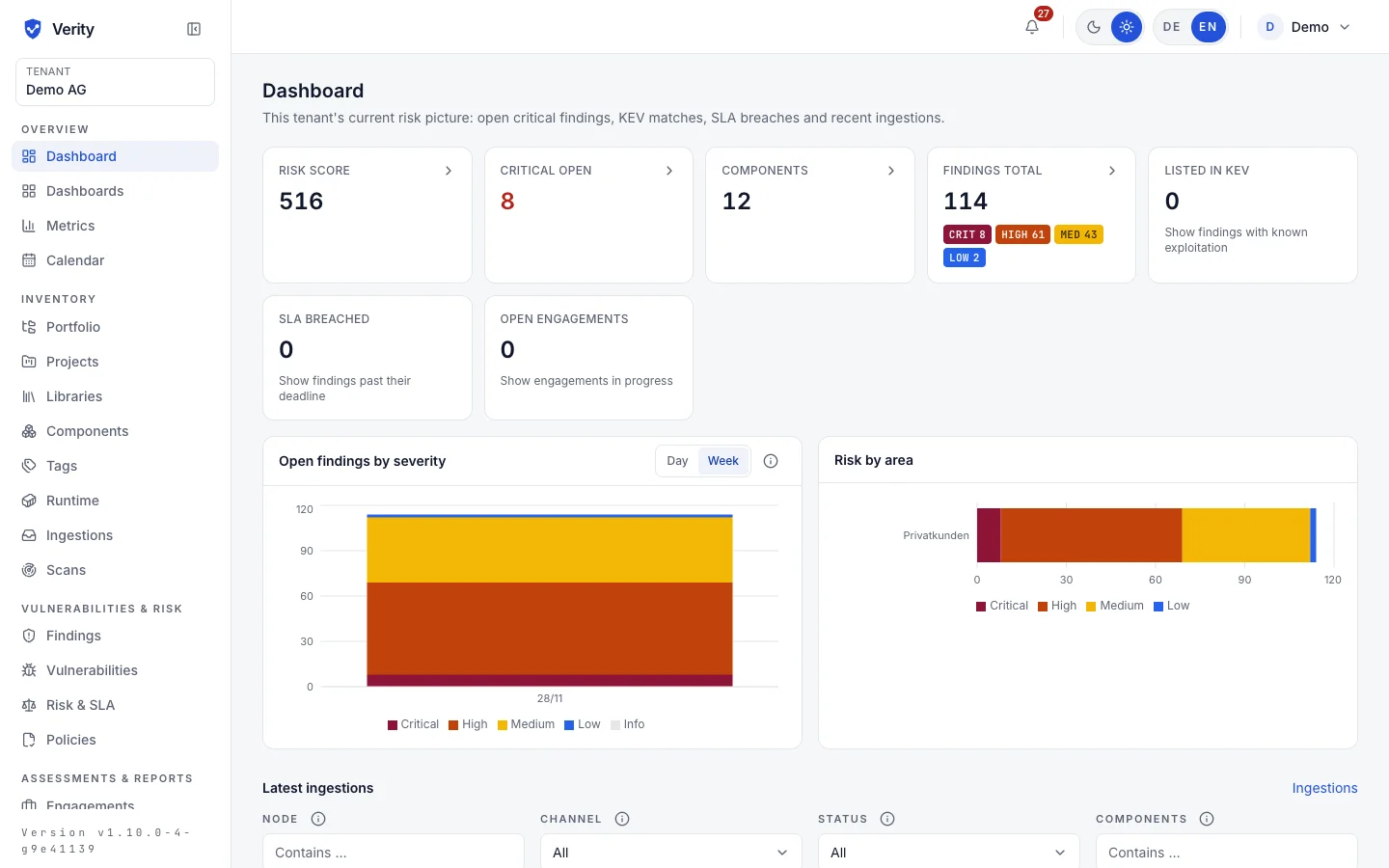
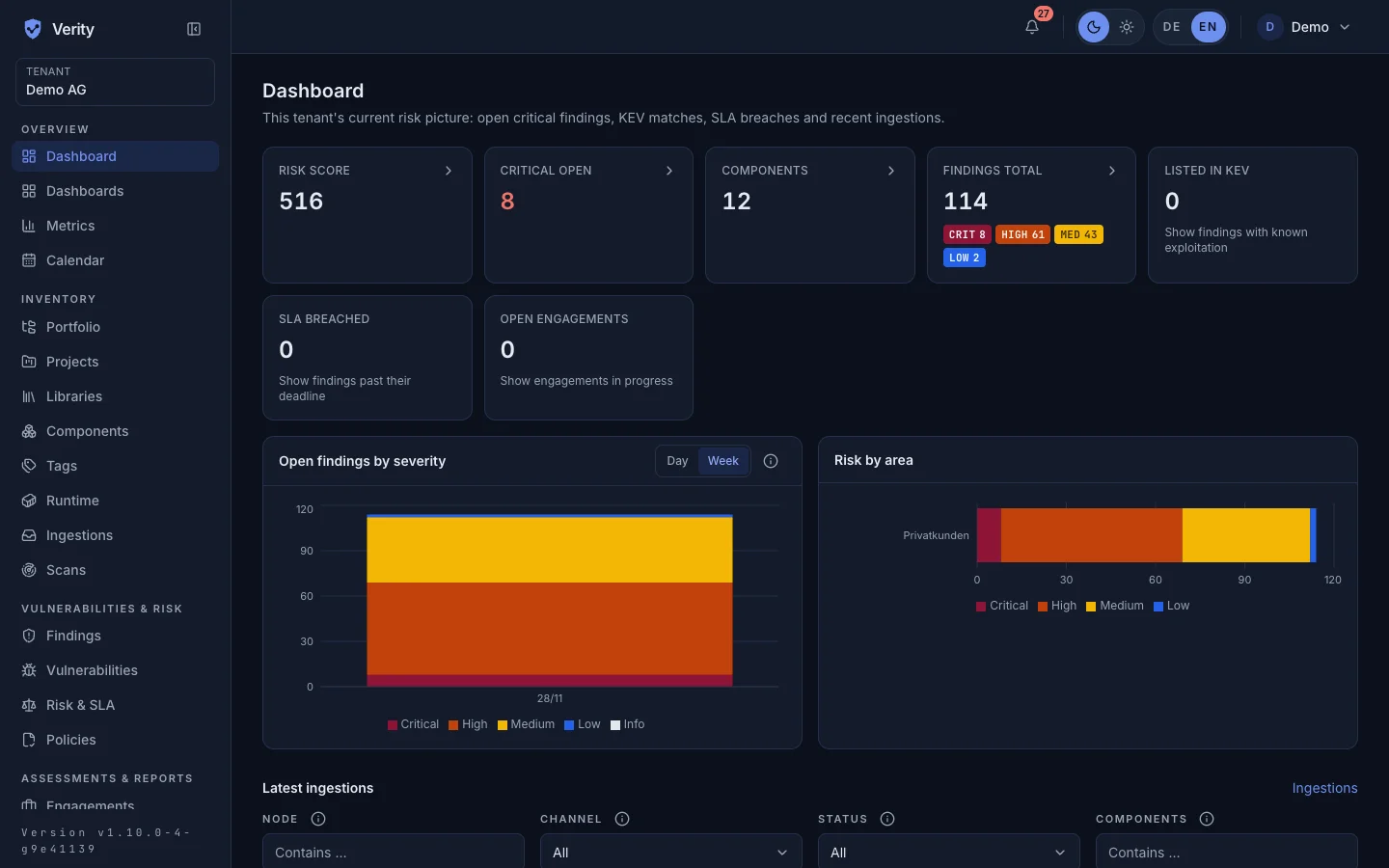
Verity solves this by combining software composition analysis in the style of Dependency-Track with the vulnerability management features of DefectDojo in one multi-tenant platform. SBOMs and scanner reports from CI pipelines, active scans, and suppliers all land in a single, deduplicated finding model that is linked to a portfolio of applications, deliveries, container images, and Kubernetes deployments. Teams triage, accept risks, enforce policies, and receive notifications in one place, and they can trace a CVE from the library version to every affected delivery and environment. Existing Dependency-Track CI integrations keep working because the SBOM upload API is compatible.
Verity is m8ty’s software supply chain and vulnerability management platform. It inventories what is built and shipped, analyzes it against public and commercial vulnerability sources, and manages the resulting findings through triage, policies, SLAs, and reports.
Capabilities
Section titled “Capabilities”- SBOM inventory — Dependency-Track-compatible upload of CycloneDX (JSON/XML) and SPDX JSON, immutable snapshots, a per-tenant library catalog, and container image artifacts identified by digest.
- Vulnerability analysis — OSV by default, with optional NVD enrichment, EPSS, KEV catalogs, GitHub Advisories, OSS Index, Snyk, Trivy server, VulnDB, Checkmarx SCA, JVN, and internal vulnerabilities; daily re-analysis.
- Unified findings — one finding model for SBOM analysis, scanner imports, and manual findings, with alias-based deduplication, triage, VEX, risk acceptances, SLAs, and ticket integration.
- Engagements and scanner import — DefectDojo-style engagements and tests with parsers for common scanner formats and a configurable universal parser.
- Policies and notifications — CEL-based policies, license and vulnerability policies, and notification rules for e-mail, webhooks, chat tools, Jira, and Kafka.
- Deliveries and runtime — versioned deliveries with release freeze, Kubernetes synchronization of running workloads, base image currency checks, and impact analysis across projects.
- Active scanning — scheduled Syft, Trivy, and cdxgen scans of images and Git repositories, as Docker containers or hardened Kubernetes jobs.
- Reporting — metrics, dashboards, scheduled reports (PDF, HTML, CSV, XLSX), badges, OWASP ASVS benchmarks, and migration from Dependency-Track and DefectDojo.
Documentation
Section titled “Documentation”| Topic | Description |
|---|---|
| Product and Architecture | Domain model, functional areas, architecture, and architecture decisions |
| API | OpenAPI contract, authentication, permissions, endpoint groups, and SBOM upload |
| Deployment and Operations | Local setup, Docker Compose, Helm chart, releases, and CI integration |
See Also
Section titled “See Also”- Verity: Product and Architecture — what Verity models and how it is built
- Verity API — integrating CI pipelines and other machine clients
- Verity: Deployment and Operations — running Verity locally and on Kubernetes
- Secure Software Development Process — development and delivery controls
© m8ty GmbH 2023 · m8ty.eu