Verity: Product and Architecture
Verity combines the structure and feature set of Dependency-Track (SBOM inventory and component analysis) with the vulnerability management domain of DefectDojo (engagements, scanner imports, SLAs, risk acceptance). This page describes the domain model, the functional areas, and the technical architecture.
Domain model
Section titled “Domain model”Customers and accounts
Section titled “Customers and accounts”A customer (tenant) is the unit of data isolation. All customers share one PostgreSQL database; every table with customer data carries a tenant_id, and every query is checked by a central tenant access service.
| Concept | Description |
|---|---|
| Customer account | A person or service account that belongs to exactly one customer and has one role: READER, WRITER, MAINTAINER, or OWNER |
| Platform account | A system administrator (superuser) without a customer; manages customers and system settings but never sees customer data |
| Service account | A customer account of kind SERVICE without a password; authenticates with API keys or workload identity |
| Subdomain | Each customer works under its own subdomain (<slug>.verity.example.com); system administration runs under admin. |
Usernames are unique per customer, so admin as platform account and admin in a customer are two separate accounts. Nobody can grant a role higher than their own, and the last OWNER of a customer cannot be removed.
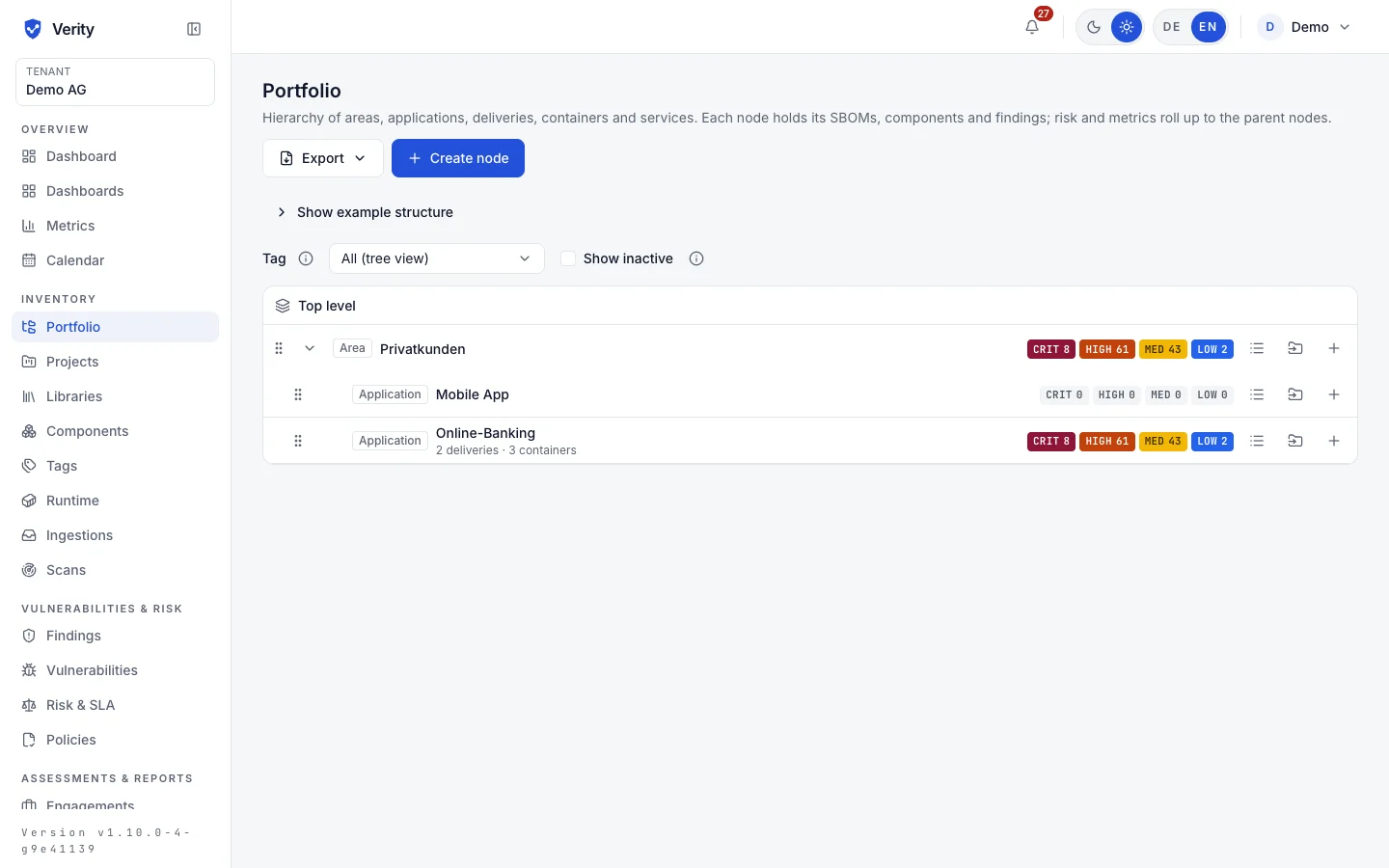
Portfolio tree
Section titled “Portfolio tree”The portfolio is a tree of nodes stored with a closure table:
| Node type | Purpose |
|---|---|
AREA |
Organizational grouping, for example a business unit |
APPLICATION |
A product or system, optional parent for deliveries and containers |
DELIVERY |
A versioned bundle of pinned container or service versions |
CONTAINER |
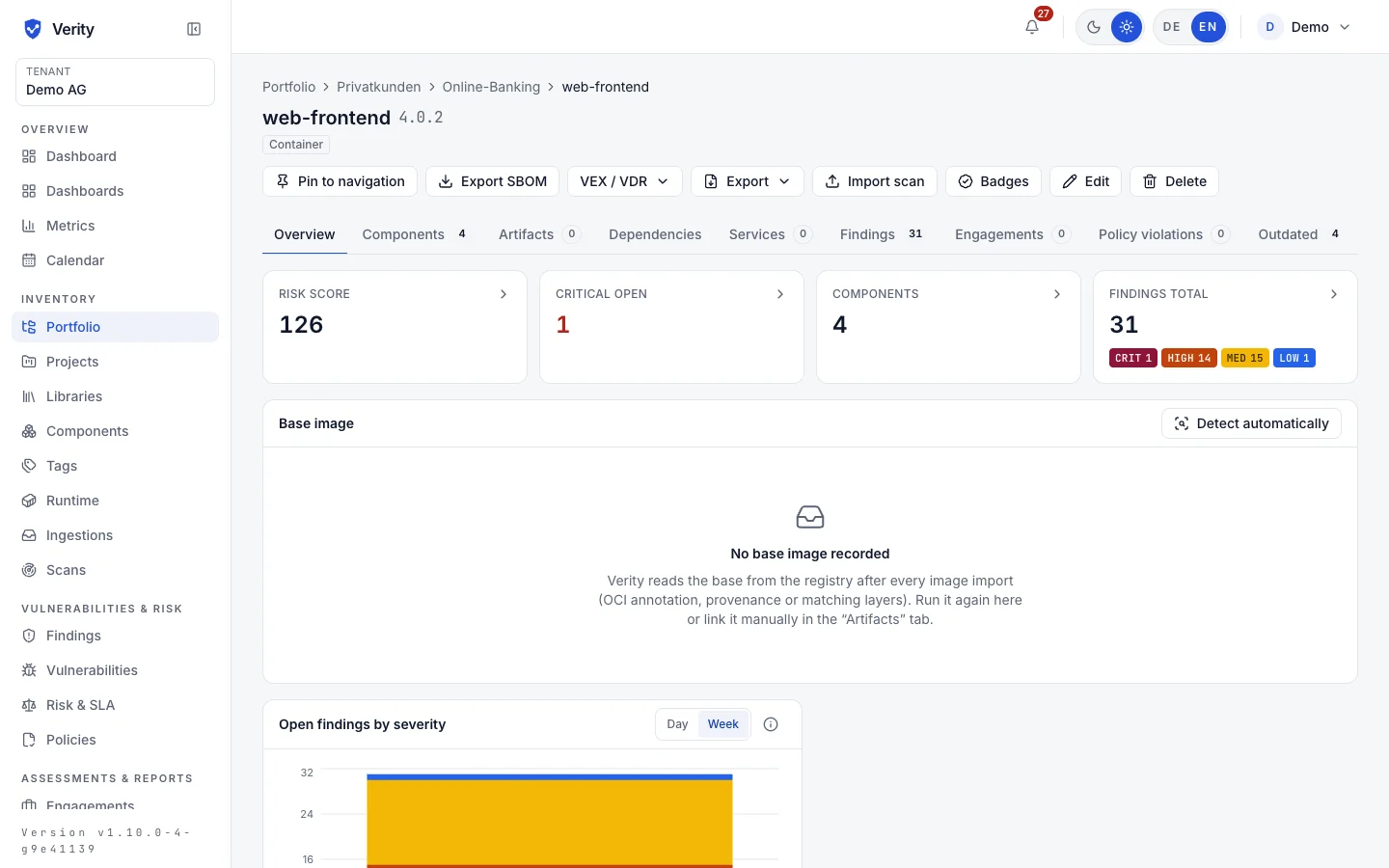
A container image; a base image is a regular container that others build on |
SERVICE |
A non-container deployable or package |
Containers, services, and deliveries may sit directly under the root or an area; an application is optional.
Deliveries
Section titled “Deliveries”A delivery moves through DRAFT, IN_REVIEW, and RELEASED. Verity shows the difference to the previous delivery. On release, Verity freezes the current inventory snapshot of every contained node together with the analysis state at that time. Later SBOM imports change only the current state of the containers, not the frozen content of a released delivery. Verity can still re-evaluate frozen content against new vulnerability knowledge.
A delivery can also be filled from a manifest: a CycloneDX BOM with container components (optionally with nested SBOMs) or a docker-compose.yml.
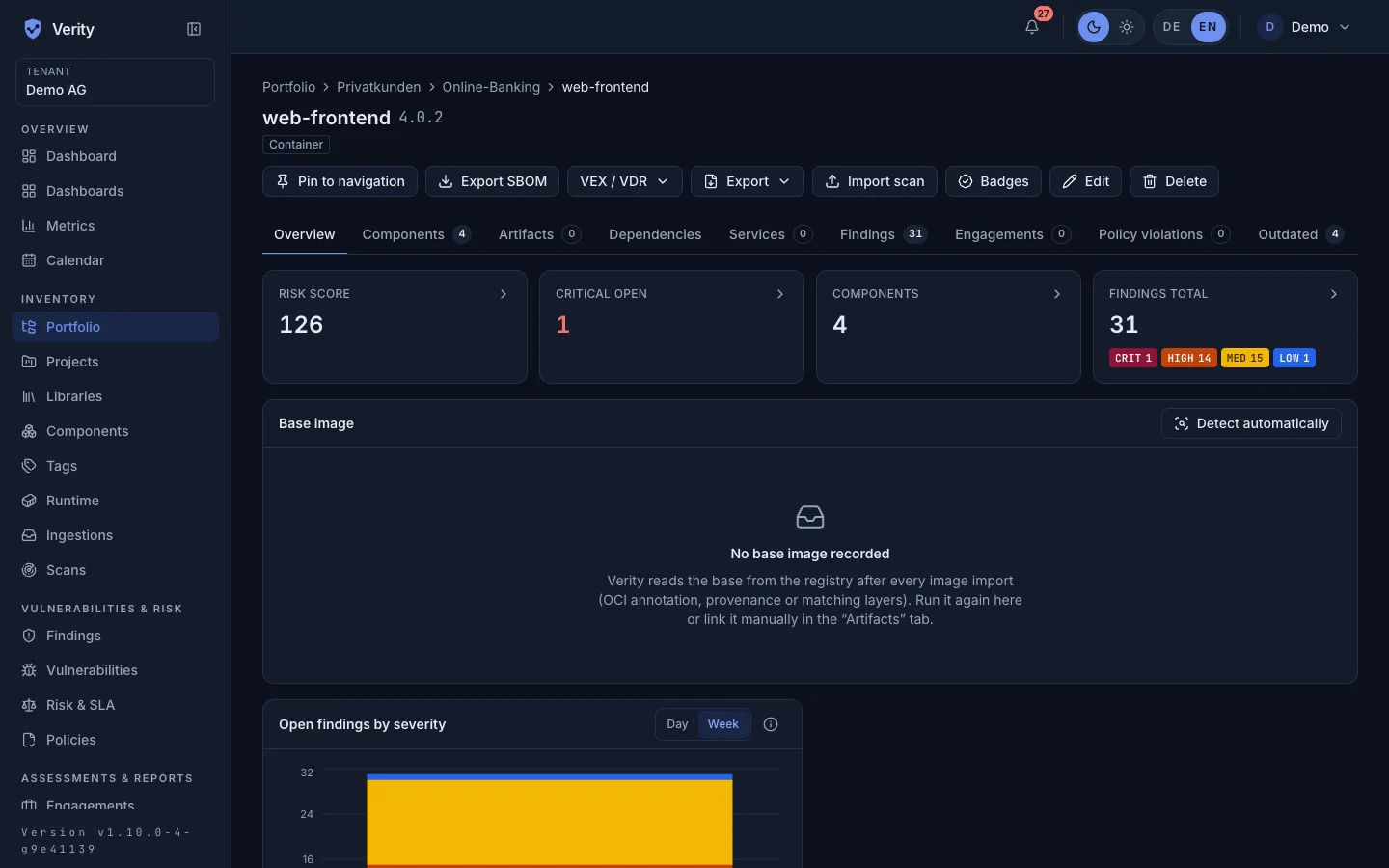
Projects
Section titled “Projects”Business projects are free groupings that reference existing nodes, with multiple assignment allowed and no duplication of artifacts or snapshots. A project’s scope is the set of assigned nodes including descendants and the containers of assigned deliveries; metrics are computed over this set without double counting. Users can pin projects to their navigation.
Components and artifacts
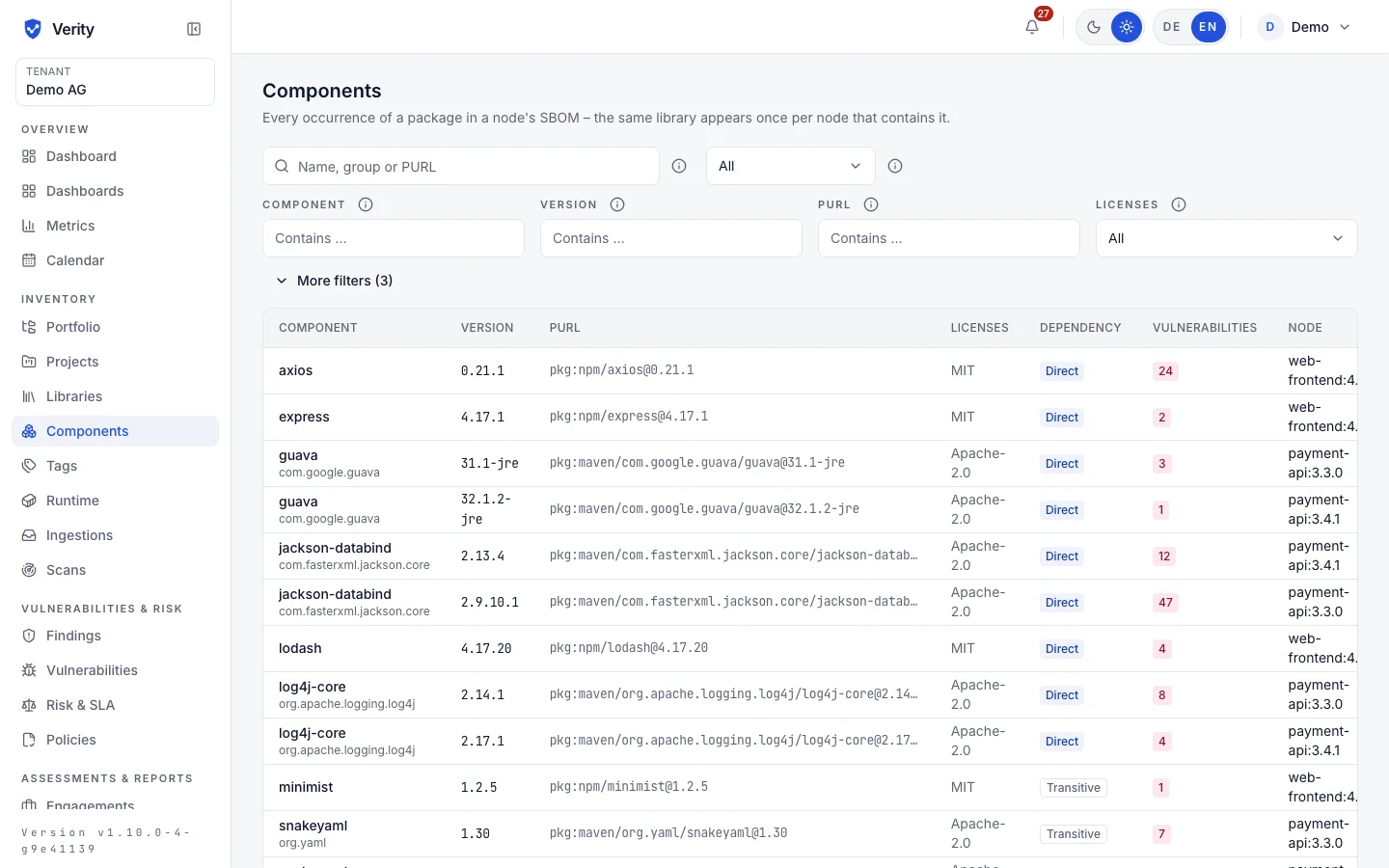
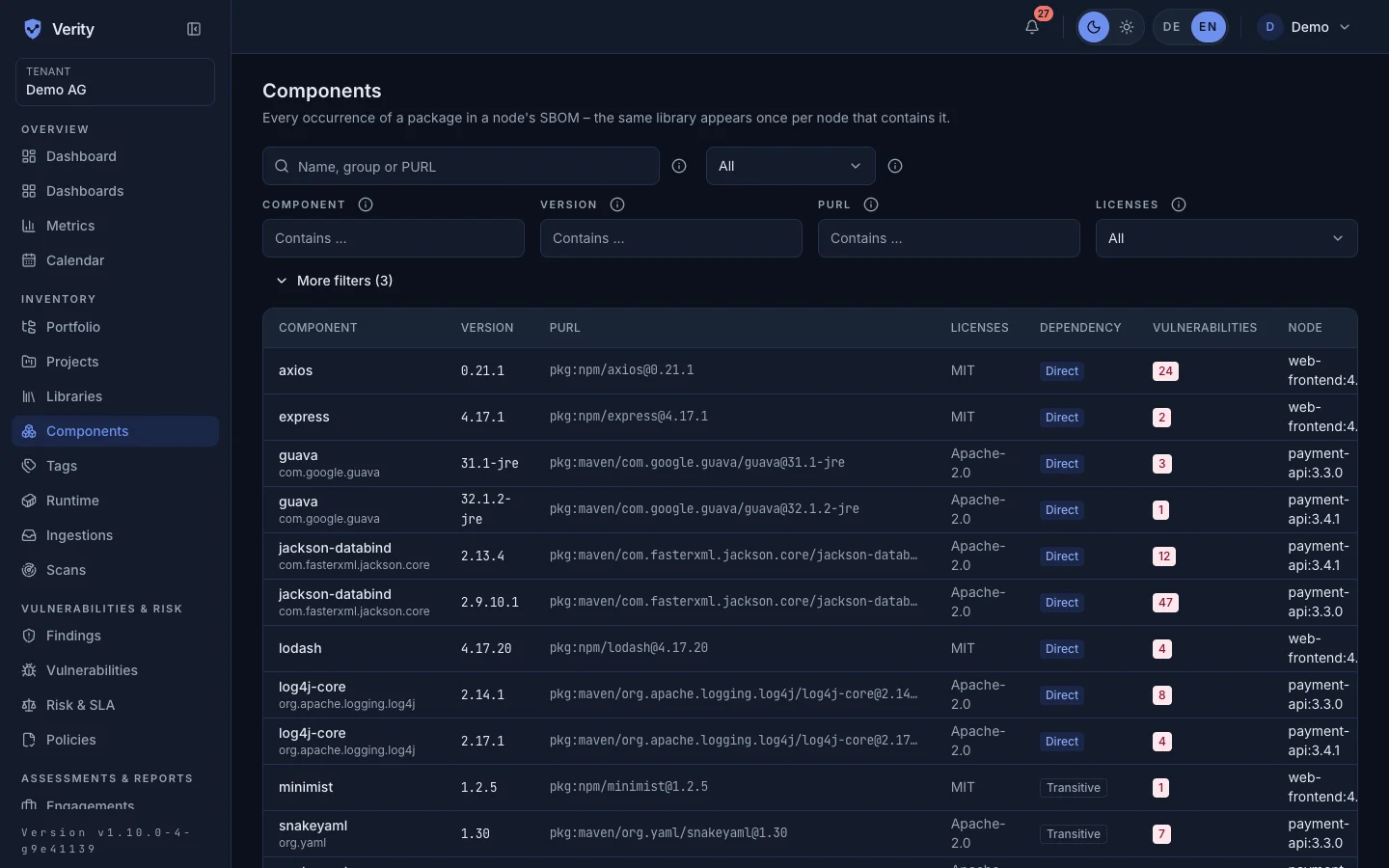
Section titled “Components and artifacts”| Concept | Description |
|---|---|
| Library catalog | One entry per customer and normalized package URL (PURL) identity; fallback identities use CPE or name and version |
| Artifact | A concrete image identified by registry, repository, and digest; tags are kept as history |
| Snapshot | Immutable content of one ingestion for an artifact or node; identical content yields the same snapshot |
| Ingestion | Raw SBOM file with hash, channel, format, provenance (pipeline URL, build ID, commit), actor, and timestamps |
| Lineage | “Built on” relationship between an application image and its base image, with evidence (MANUAL, BUILD_METADATA, PROVENANCE, OTHER) |
Findings
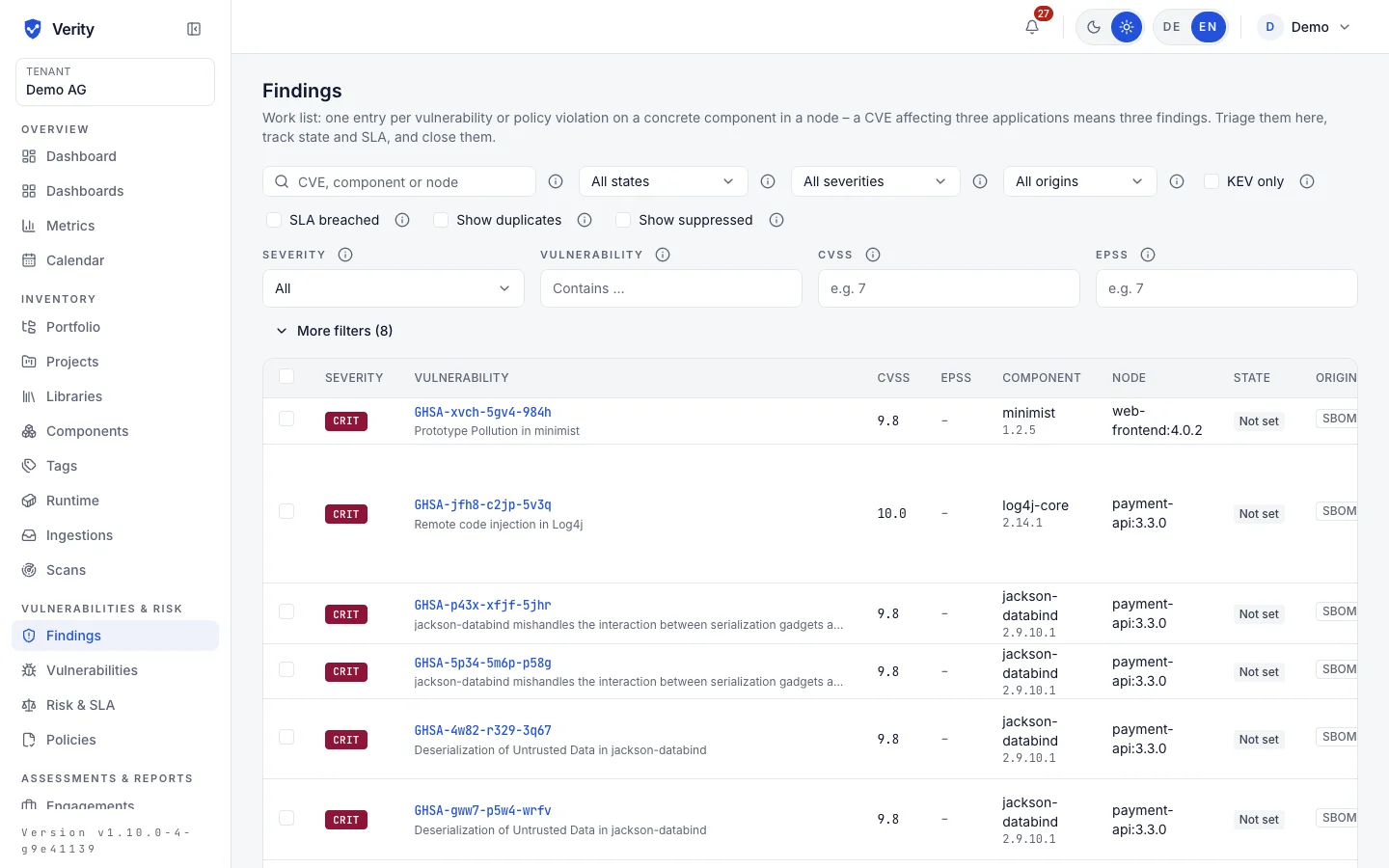
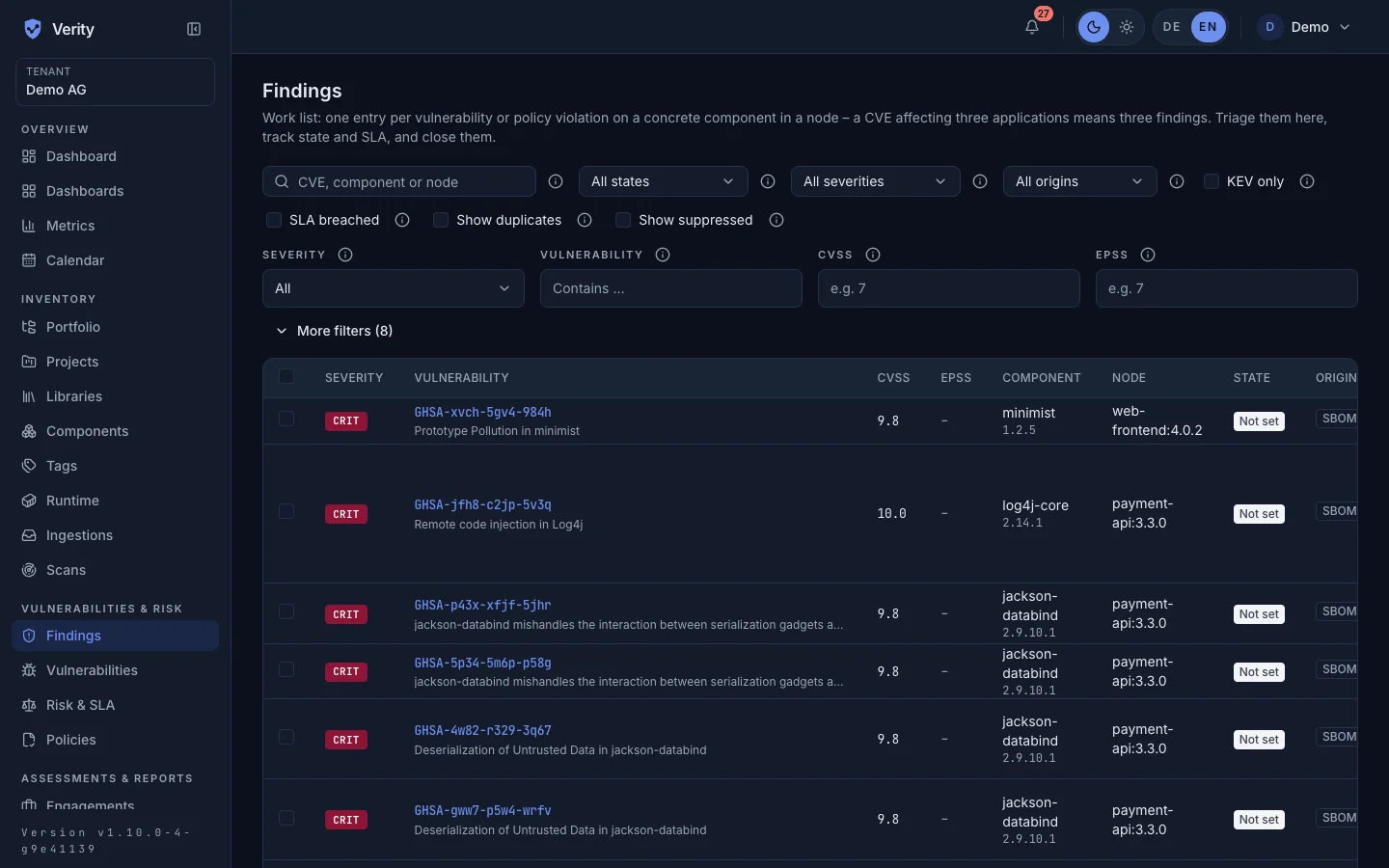
Section titled “Findings”A finding is the single model for results from SBOM analysis, scanner imports, and manual entry. Assessments (triage, VEX, suppressions, risk acceptances) apply per container or service node and never relieve another application, project, or customer.
Functional areas
Section titled “Functional areas”SBOM import
Section titled “SBOM import”- Upload of CycloneDX (JSON or XML) and SPDX JSON through a Dependency-Track-compatible multipart endpoint, by API key, workload identity token, or from the UI.
- Asynchronous, durable processing; the upload returns a token for status polling.
- Idempotency through an
idempotencyKeyor identical content to the same target. - Optional artifact identity (
imageRef,imageDigest,artifactVersion) and provenance; a digest that contradicts the SBOM is rejected. - Automatic target creation with
autoCreate=true. - CycloneDX 1.6 export per node, including nested container components for deliveries.
- Supplier links: a supplier without an account can upload SBOMs with a token in the
X-Supplier-Tokenheader.
Vulnerability analysis and sources
Section titled “Vulnerability analysis and sources”Analysis runs per package URL and source. The state of a library version is NOT_ANALYZED, NO_KNOWN_VULNERABILITIES, AFFECTED, SOURCE_UNAVAILABLE, or STALE. If a source is unavailable, findings from that source are not reconciled, so an outage never closes open findings.
| Source or analyzer | Default |
|---|---|
| OSV (includes GHSA, PyPA, Go, RustSec, and others) | On |
| Internal vulnerabilities (version ranges per PURL) | On |
| EPSS (FIRST) | On, daily |
| KEV CISA | On, daily |
| KEV ENISA (EUVD), KEV VulnCheck | Off |
| NVD (CVSS and CWE enrichment) | Off |
| Sonatype OSS Index, Snyk, GitHub Advisories | Off |
| Trivy server mode, VulnDB, Checkmarx SCA (Checkmarx One), JVN iPedia | Off |
| Repository metadata (outdated components, integrity) | On |
Feeds synchronize daily and all components are re-analyzed daily. Built-in calculators cover CVSS (v2, v3, v4) and the OWASP Risk Rating. Vulnerabilities can be tagged, and a CVE impact view resolves aliases and traces a vulnerability through library versions, usages, artifacts, deliveries, and deployments.
Findings, deduplication, and triage
Section titled “Findings, deduplication, and triage”- Deduplication across aliases (for example GHSA and CVE) and reconciliation on reimport.
- Analysis states
NOT_SET,IN_TRIAGE,EXPLOITABLE,NOT_AFFECTED,FALSE_POSITIVE,RESOLVED, with justification and audit trail; bulk triage per customer. - VEX import and export and VDR export per node.
- Workflow with notes, attachments, reviews, finding groups, duplicate clusters, and finding templates.
- Risk acceptances with expiry and reinstatement, SLA profiles with daily breach checks, and configurable severity thresholds.
- Ticket integration with Jira, GitHub, and GitLab, including a Jira webhook.
- Export to Fortify Software Security Center (FPF) and Kenna (KDI) as export targets.
Policies
Section titled “Policies”- Policies with conditions on severity, license, license group, PURL, CPE, coordinates, version, hash, CWE, EPSS, KEV, vulnerability ID, age, outdated state, version distance, and CEL expressions.
- Violation types
SECURITY,LICENSE, andOPERATIONAL, with violation triage. - License catalog with custom licenses and license groups.
- Vulnerability policies, including import.
Notifications
Section titled “Notifications”Notification rules route events such as new vulnerabilities, new KEV entries, BOM processing, policy violations, analysis changes, scan results, released deliveries, SLA breaches, and expired risk acceptances. Digest summaries are available for new vulnerabilities and policy violations.
| Publisher | Publisher |
|---|---|
| Console (in-app) | |
| Webhook | Slack |
| Microsoft Teams | Mattermost |
| Webex | Jira |
| Kafka |
System-wide rules receive only events without a customer; customer events go only to that customer’s rules.
Engagements and scanner import
Section titled “Engagements and scanner import”DefectDojo-style engagements (INTERACTIVE or CI_CD) contain tests. Scanner reports are imported into a test and reimported with reconciliation, for example closing findings that are no longer reported.
Supported scan types include Trivy, Anchore Grype, OSV, CycloneDX, OWASP Dependency-Check, npm audit, Snyk, SARIF, Semgrep, Gitleaks, ZAP, and the DefectDojo Generic Findings Import (JSON and CSV). The universal parser maps custom JSON or CSV formats through field paths and then appears as an additional scan type. Engagements also track endpoints (hosts and URLs).
Active scanning
Section titled “Active scanning”Scan targets of kind IMAGE, GIT, or FILESYSTEM are scanned with Syft, Trivy, or cdxgen. Actions are INVENTORY (scanner, import, analysis), REANALYSIS (analysis only), and BASE_IMAGE_CHECK (registry comparison).
- Cron schedules (6 fields) in the target’s time zone; manual runs and runs triggered by API key from CI.
- No parallel runs per target; a limited number of parallel scanners per instance, with timeout and automatic retries for scheduled runs.
- Project-wide bulk runs that start each target once.
- Registry credentials are kept once per registry host and are used by both image scans and base image checks; Git credentials are kept separately.
- Scanners run as Docker containers or as hardened Kubernetes jobs (see Deployment and Operations). Directory targets are not supported with the Kubernetes runner.
Runtime
Section titled “Runtime”- Environments (
DEV,TEST,UAT,PROD,OTHER), clusters, and namespaces. - Deployments compare desired state (artifact, delivery, or image reference, also via delivery rollouts) with observed state; states include
CONFIRMED,DRIFT,DIGEST_UNKNOWN,OBSERVED_ONLY,NOT_OBSERVED,STALE, andREMOVED, with event history. - Observed state is reported through the API (permission
DEPLOYMENT_REPORT) or synchronized from Kubernetes on a schedule. The synchronization reads Deployments, StatefulSets, DaemonSets, Jobs, CronJobs, and Pods with read-only permissions and never creates portfolio nodes. - Namespaces can be mapped to business projects.
Base images
Section titled “Base images”A base image is a container that other artifacts build on or that has a currency rule. Verity checks base images against their registry through the OCI distribution API (anonymous, basic, or token authentication) and reports CURRENT, NEWER_AVAILABLE, DIGEST_CHANGED, NOT_APPROVED, SUPPORT_EXPIRED, VULNERABLE, or UNKNOWN. Dependent images built on an older version are marked as needing a rebuild. Base images can also be detected from image metadata.
Landscape
Section titled “Landscape”The landscape module provides read-only views across modules: project overview, severities per project, vulnerability and library impact, base image dependents, and the delivery vulnerability view, which separates frozen content, the analysis state at release, and current knowledge about exactly that content.
Reporting and metrics
Section titled “Reporting and metrics”- Metrics and history per customer, area, application, delivery, and container, with an overview, insights (for example MTTR and finding flow), and a calendar.
- Configurable dashboards with widgets.
- Report definitions with sections such as summary, severity trend, findings, components, licenses, policy violations, SLA, risk acceptances, and engagements; formats PDF, HTML, CSV, and XLSX; scheduled generation and e-mail delivery.
- Vulnerability and policy violation badges per node.
Benchmarks
Section titled “Benchmarks”OWASP ASVS catalogs are imported from the official JSON export and assessed per node (OPEN, PASS, FAIL, NOT_APPLICABLE). Questionnaires with text and choice questions can be answered per engagement.
Migration
Section titled “Migration”Background jobs import data from Dependency-Track (projects become applications and containers, SBOMs, assessments as VEX) and DefectDojo (products, engagements, tests, findings with state). Source API keys are not stored. If an egress allowlist is configured, the source host must be allowed.
Secrets
Section titled “Secrets”Named secrets are stored globally (superuser) or per customer (MAINTAINER or OWNER), encrypted with AES-256-GCM, and never returned, logged, or audited. Integrations such as trackers, export targets, notification rules, and the GitHub token for repository metadata reference secrets by name.
Workload identity
Section titled “Workload identity”CI jobs exchange a short-lived OIDC ID token of their platform (GitLab CI id_tokens, GitHub Actions) for a Verity token of a customer service account (RFC 8693 token exchange), so no secret is stored in the CI configuration.
- A superuser registers a workload identity provider (issuer and audience).
- A customer administrator creates a service account.
- A binding links provider, subject pattern (wildcards
*and?), and optional claim conditions to the service account.
Verity verifies signature (asymmetric algorithms only, keys from the issuer’s JWKS), issuer, audience, expiry, and all binding conditions. The issued token is valid for 15 minutes by default, only in the service account’s customer, and allows neither administration nor API key management. Each issuance is audited.
Administration
Section titled “Administration”| Area | Who | Content |
|---|---|---|
| System administration | Platform accounts | Customers (create, rename, delete with slug confirmation), invitations of customer administrators, platform users, vulnerability sources, system settings, retention, workload identity providers, SSO group mappings, global catalogs |
| Customer administration | MAINTAINER, OWNER |
Member invitations by e-mail, password reset links, service accounts and their API keys, workload bindings, audit log, secrets |
System administration never grants access to customer data. Superusers cannot create API keys for other accounts or set passwords for others; password resets send a one-time link. Deleting a customer is final and purges all customer data in one transaction.
Authentication methods
Section titled “Authentication methods”All methods end in the same Verity JWT.
| Method | Notes |
|---|---|
| Local password | Optional TOTP as second factor; can be disabled for SSO-only installations |
| LDAP / Active Directory | Bind with DN pattern or search-then-bind; groups from memberOf or a group search; optional admin group |
| Generic OIDC | Authorization Code with PKCE; the backend exchanges the code and validates the ID token (signature, issuer, audience, expiry, nonce) |
| Microsoft Entra ID | App registration of type Web with client secret; admin via app role or group |
| Passkeys (WebAuthn) | Username-less login with user verification; replaces password and TOTP |
| API keys | Header X-Api-Key, optionally restricted to customers, permissions, and projects |
| Workload identity | OIDC token exchange for CI jobs |
External users are created on first login, but only if an invitation is open or a group mapping of the customer applies. SSO admin groups apply only to logins under admin..
Architecture
Section titled “Architecture”| Layer | Technology |
|---|---|
| API contract | OpenAPI 3 (api/openapi.yaml), OpenAPI-first |
| Backend | Kotlin, Spring Boot 4, Spring Modulith, JDK 25, virtual threads |
| Frontend | Next.js App Router, pnpm and Turborepo, design system “Instrument” |
| Database | PostgreSQL 17, schema managed by Liquibase |
| Asynchronous processing | Spring Modulith event publication registry on PostgreSQL |
| Observability | Spring Boot Actuator (health, info, Prometheus, Modulith) on a separate management port |
Backend modules
Section titled “Backend modules”The backend is a modular monolith: one deployable with one Spring Modulith module per domain. Other modules see only a module’s public API (interfaces, DTOs, events) in its root package. Each module is layered into domain (plain Kotlin), application (use cases and transactions), infrastructure (JDBC and external clients), and web (controllers implementing the generated API interfaces).
| Module | Responsibility |
|---|---|
platform |
Shared kernel: errors, security (JWT, API keys), scheduler locks, secret encryption, Kubernetes API access, audit |
identity |
Accounts, authentication, API keys, roles, invitations, service accounts, workload identity, tenant access |
portfolio |
Customers, node tree, deliveries with diff and release |
projects |
Business projects and their scope |
inventory |
SBOM ingestion, snapshots, library catalog, artifacts, components |
vulnintel |
Vulnerability catalog, feed synchronization, CVSS and OWASP scoring |
analysis |
Matching components to vulnerabilities, analyzers, repository metadata, re-analysis |
findings |
Unified findings, deduplication, triage, VEX, workflow, risk acceptances, SLA |
policy |
Policies (CEL), licenses, vulnerability policies |
notification |
Rules, routing, digests, publishers |
engagement |
Engagements, tests, scanner parsers, universal parser, endpoints, templates |
integration |
Ticket systems and export targets |
scanning |
Scan targets, credentials, runners, scheduler, supplier links |
runtime |
Environments, clusters, namespaces, deployments, Kubernetes synchronization |
baseimage |
Registries, base image detection, currency rules, registry checks |
landscape |
Read-only cross-module views and impact analysis |
reporting |
Metrics, dashboards, reports, badges |
benchmark |
ASVS catalogs and questionnaires |
migration |
Import from Dependency-Track and DefectDojo |
secrets |
Named, encrypted secrets |
Frontend
Section titled “Frontend”The Next.js frontend acts as a backend-for-frontend (BFF): the browser talks only to the web application, which keeps the session token in an httpOnly cookie and proxies /api/v1/** to the backend with a bearer token. Features live in domain folders. All styling goes through the “Instrument” design system (design tokens for colors, typography, and radii, with light and dark themes), and the UI is available in German and English. A TypeScript client is generated from the OpenAPI contract.
Architecture decisions
Section titled “Architecture decisions”| ADR | Decision |
|---|---|
| 001 | Modular monolith: one Kotlin deployable, domains as Spring Modulith modules |
| 002 | One unified finding model for SBOM analysis and scanner imports |
| 003 | Durable execution on PostgreSQL (event publication registry, outbox) instead of Kafka |
| 004 | No source file longer than 500 lines |
| 005 | Hierarchy customer, area, application, delivery, container or service, component (relaxed by ADR-012) |
| 006 | Tenant isolation: every query checks tenant access |
| 007 | OpenAPI-first: the contract generates Kotlin interfaces and the TypeScript client |
| 008 | The “Instrument” design system is the only source of styling |
| 009 | Continuous CVE checks of dependencies and images (OWASP Dependency-Check, Trivy), BellSoft base images, Renovate updates |
| 010 | Every feature has tests, every change invalidates affected caches, code is split by domain and topic |
| 011 | Authentication: local, LDAP/AD, Entra ID and OIDC with code exchange in the backend, passkeys |
| 012 | Business projects, library catalog, artifacts, and runtime modeled separately; immutable snapshots, frozen deliveries, analysis state per source |
| 013 | System administration without access to customer data; final customer deletion across all modules |
| 014 | Active scans in the cluster as hardened Kubernetes jobs instead of privileged Docker-in-Docker; SBOM returned by upload with a one-time token |
| 015 | One registry credential per host, shared by base image checks and image scans |
| 016 | Every account belongs to exactly one customer; separate platform accounts; one subdomain per customer |
See Also
Section titled “See Also”- Verity — product overview
- Verity API — authentication, permissions, and endpoints
- Verity: Deployment and Operations — installation and operations
© m8ty GmbH 2023 · m8ty.eu