AI Chat
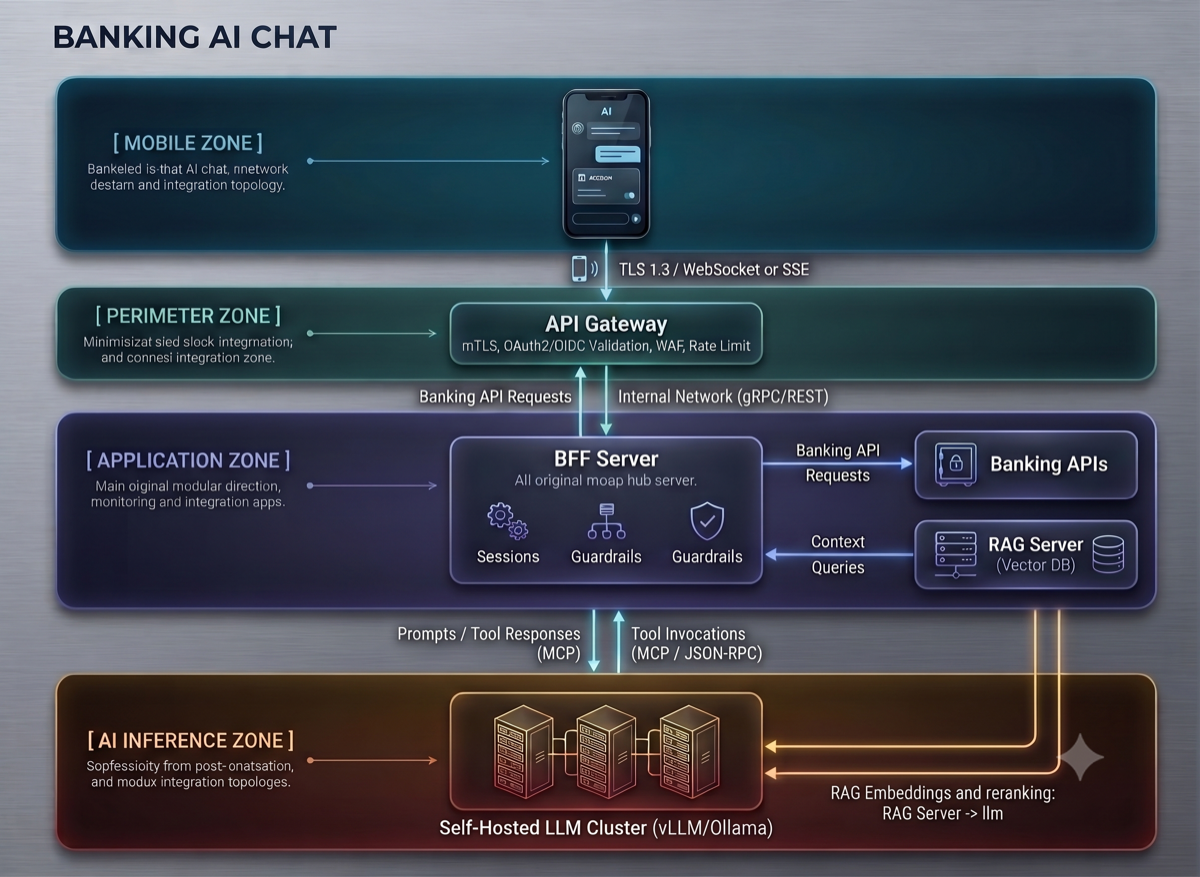
The BFF Server provides a streaming AI chat endpoint that acts as a Backend-for-Frontend (BFF) orchestrator. Any client sends conversation history and optionally a system prompt; the server handles LLM interaction, tool selection, and tool execution internally.
Architecture Overview
Section titled “Architecture Overview”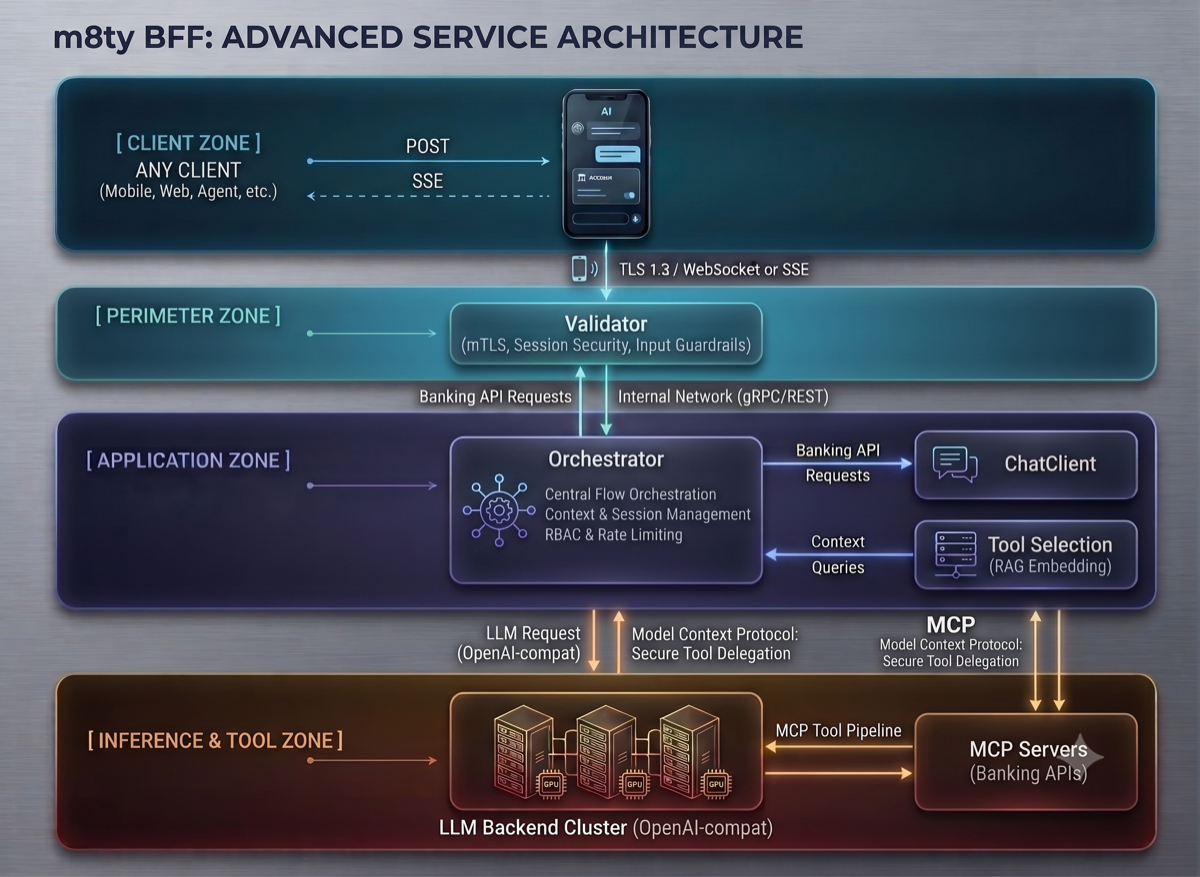
Detailed Request Flow
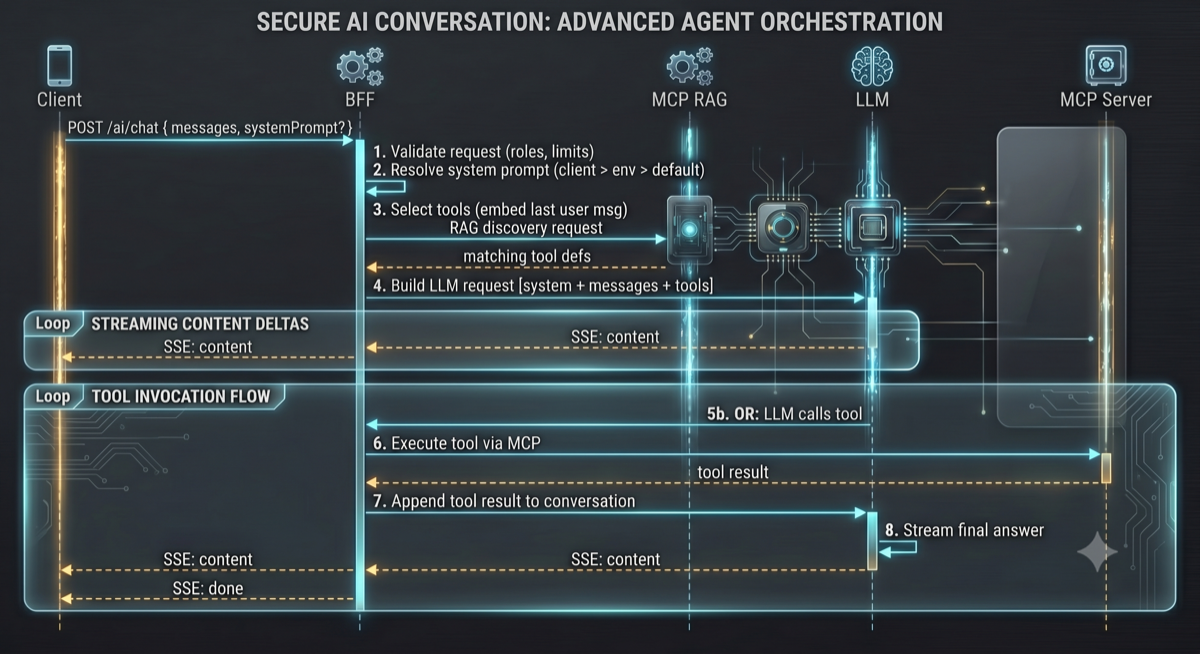
Section titled “Detailed Request Flow”The following diagram shows the complete sequence of a single AI chat request, including tool call handling:
Flow Steps
Section titled “Flow Steps”-
Validation — The BFF validates the request: messages non-empty, within limits (max 30), content not blank, last message is
userrole. -
System Prompt Resolution — Priority: client-provided
systemPrompt→ environment variableM8TY_AI_CHAT_SYSTEM_PROMPT→ built-in default. -
Tool Selection — The latest user message is embedded and compared against the MCP RAG tool catalog via semantic search. Only the top-K matching tools (above minimum score) are selected.
-
LLM Request — The BFF constructs a full OpenAI-compatible request: system message + conversation history + selected tool definitions.
-
Streaming Response — The LLM streams back either content deltas (forwarded as SSE to client) or tool call requests.
-
Tool Execution — When the LLM requests a tool call, the BFF executes it via MCP using the client’s Bearer token for authentication.
-
Conversation Loop — Tool results are appended to the conversation and sent back to the LLM for the next iteration (max iterations configurable).
-
Final Answer — Once the LLM produces a text response (no more tool calls), it is streamed to the client followed by a
doneevent.
Endpoint
Section titled “Endpoint”POST /api/v1/ai/chatAuthorization: Bearer <user-token>Content-Type: application/jsonResponse: text/event-stream
Request Format
Section titled “Request Format”| Field | Type | Required | Description |
|---|---|---|---|
messages |
Array | Yes | Chronological user/assistant conversation history. Min 1 item. Last message must be user. |
systemPrompt |
String | No | Custom system instruction (max 8000 chars). If omitted, the server default is used. |
Each message object:
| Field | Type | Description |
|---|---|---|
role |
String | user or assistant |
content |
String | Message text (non-blank) |
Response Format (SSE)
Section titled “Response Format (SSE)”The response is a stream of server-sent events. Each event has a type and JSON payload:
| Event Type | Description |
|---|---|
content |
Assistant text delta — append to the response |
done |
Stream complete |
error |
Error occurred — treat as terminal |
Examples
Section titled “Examples”Simple question (no history)
Section titled “Simple question (no history)”{ "messages": [ {"role": "user", "content": "What accounts do I have?"} ]}Follow-up with conversation history
Section titled “Follow-up with conversation history”{ "messages": [ {"role": "user", "content": "What accounts do I have?"}, {"role": "assistant", "content": "You have 3 accounts: checking (€2,450), savings (€15,200), and a securities depot."}, {"role": "user", "content": "Which one had the latest transaction?"} ]}With custom system prompt
Section titled “With custom system prompt”{ "systemPrompt": "You are a retirement planning advisor. Answer in German. Always use tools for portfolio data.", "messages": [ {"role": "user", "content": "Wie entwickelt sich mein Depot?"} ]}SSE response example
Section titled “SSE response example”event: contentdata: {"type":"content","content":"Your checking account had the latest transaction: "}
event: contentdata: {"type":"content","content":"a SEPA debit of €89.99 to Netflix on June 10."}
event: donedata: {"type":"done","finishReason":"stop"}System Prompt
Section titled “System Prompt”The system prompt defines assistant behavior. It is resolved in this priority:
- Client sends
systemPromptin request — used for that specific request - Environment variable
M8TY_AI_CHAT_SYSTEM_PROMPT— used as the server default - Built-in default — banking assistant instruction (see below)
Built-in default system prompt
Section titled “Built-in default system prompt”Conversation History
Section titled “Conversation History”The server is stateless — it does not persist conversations. The client owns the history:
- Client stores full conversation locally (e.g. secure storage, database)
- On every new user message, client sends the entire relevant history
- Server processes it, returns the assistant response via SSE
- Client appends the new assistant response to local history
- Next request includes all prior messages again
This follows the standard pattern used by OpenAI and other chat APIs.
History limits
Section titled “History limits”| Constraint | Default | Env Variable |
|---|---|---|
| Max messages per request | 30 | M8TY_AI_CHAT_MAX_MESSAGE_COUNT |
| Max content per message | 32,000 chars | M8TY_AI_CHAT_MAX_CONTENT_LENGTH |
Clients should trim oldest message pairs when approaching the limit.
Configuration
Section titled “Configuration”All settings are configurable via environment variables:
| Variable | Description | Default |
|---|---|---|
M8TY_AI_CHAT_LLM_BASE_URL |
LLM backend base URL | http://localhost:8000 |
M8TY_AI_CHAT_LLM_PATH |
Chat completions endpoint path | /v1/chat/completions |
M8TY_AI_CHAT_LLM_API_KEY |
API key for the LLM backend | — |
M8TY_AI_CHAT_LLM_AUTHORIZATION_HEADER |
Custom authorization header value | — |
M8TY_AI_CHAT_LLM_MODEL |
Model identifier | default |
M8TY_AI_CHAT_LLM_REQUEST_TIMEOUT |
Request timeout | 120s |
M8TY_AI_CHAT_LLM_DISABLE_THINKING |
Disable thinking/reasoning mode | false |
M8TY_AI_CHAT_MAX_MESSAGE_COUNT |
Max messages per request | 30 |
M8TY_AI_CHAT_MAX_CONTENT_LENGTH |
Max content length per message | 32000 |
M8TY_AI_CHAT_MAX_TOOL_CALL_ITERATIONS |
Max tool call loop iterations | 3 |
M8TY_AI_CHAT_TOOL_SELECTION_TOP_K |
Top-K tools selected per request | 8 |
M8TY_AI_CHAT_TOOL_SELECTION_MIN_SCORE |
Minimum relevance score for tool selection | 0.25 |
M8TY_AI_CHAT_SYSTEM_PROMPT |
Default system prompt | Built-in banking instruction |
Tool Selection
Section titled “Tool Selection”The BFF automatically selects relevant MCP tools for each request:
- Extracts the latest
usermessage as a semantic query - Uses the MCP RAG embedding search to find matching tools (top-K, min score)
- Sends only the selected tools to the LLM — not the full catalog
- When the LLM calls a tool, the BFF executes it using the client’s Bearer token
- Tool results are fed back to the LLM until a final text answer is produced
The client does not need to know about tools — all orchestration is server-side.
Tool call iteration limit
Section titled “Tool call iteration limit”If the LLM keeps calling tools without producing a final answer, the loop is capped at M8TY_AI_CHAT_MAX_TOOL_CALL_ITERATIONS (default: 3). After that, an error event is emitted.
Security
Section titled “Security”- Authentication: Every request must carry a valid Bearer token
- Token forwarding: The client’s Bearer token is forwarded to MCP servers for tool execution — ensuring tool calls respect the user’s permissions
- No secrets in messages: The API rejects system/tool/developer roles from clients. Only
userandassistantare accepted. - Content isolation: Tool call internals (arguments, raw results) are not exposed to the client
Validation Rules
Section titled “Validation Rules”messagesmust not be emptymessagesmust not exceed 30 items (configurable)- Each
contentmust not be blank - Each
contentmust not exceed 32,000 characters (configurable) - Last message must have role
user - Only
userandassistantroles are accepted
Error Responses
Section titled “Error Responses”| Status | Condition |
|---|---|
| 400 | Validation failure (empty messages, content too long, wrong role) |
| 401 | Missing or invalid Bearer token |
| 500 | Internal server error |
Errors within the stream are delivered as SSE error events:
event: errordata: {"type":"error","error":"Maximum tool-call iterations reached"}© m8ty GmbH 2023 · m8ty.eu